What is the internal follow-up procedure?
The internal follow-up report (IFR) is a mandatory EPD review, conducted by the EPD Owner or LCA Consultant, to ensure that the EPD content and results remain accurate and representative or whether any information in the EPD needs to be updated. The follow-up shall be done at least annually, based on last version date, and should be made with a frequency that will allow for an acceptable coverage of changes that might occur. If the EPD Verifier has been contracted to participate in the internal follow-up, the verifier should be updated on the current validity of the EPD and informed of any changes.
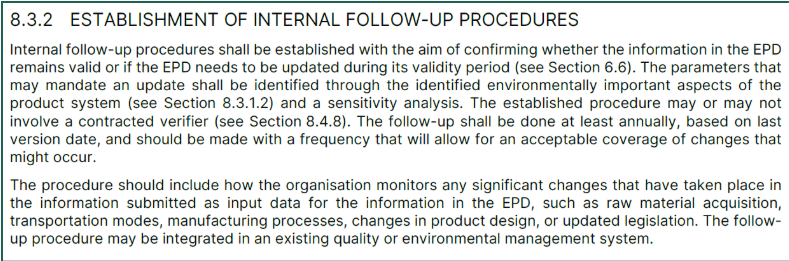
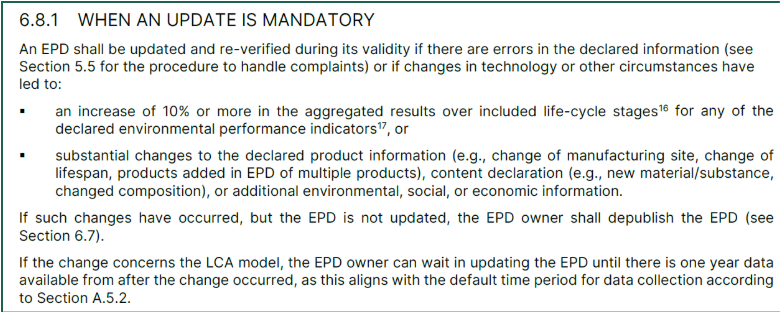
As outlined in GPI 5, during the validity period of the EPD it is not necessary to annually perform a full LCA, but monitoring of key parameters that were identified in the background LCA study is required. An EPD shall be updated and re-verified during its validity if changes in technology or other circumstances have led to an increase in emissions or substantial changes to the declared information, as summarised in the GPI 5.0.1 section 6.8.1.
Additional examples of changes in technology and other circumstances include significant updates of applied datasets, changes in underlying data and information retrieved from suppliers, updates of EPDs used as a data source, or the release of more representative datasets applicable to the product system. Detailed requirements for data quality are specified in the PCR/c-PCR and GPI, and these requirements shall always take precedence.
Suggested steps in the Internal FOLLOW-UP
These are four suggested steps introduced by the template:
Identify hotspots and prepare questions
Interpretation of results of the environmental performance indicators from the EPD background report should identify the environmental ‘hotspots’ and the key data (LCI) or processes (e.g. product mix, electricity, gas, diesel consumption, etc.) that if changed could trigger a +10% deviation of EPD environmental impact indicator results. Based on these triggers specific yes/no questions should be developed.
Prepare the IFR template
The yes/no questions relating to the hotspots, key data, and other triggers should be added to the IFR template at the end of the initial EPD verification process1 by the LCA Consultant/EPD Owner in coordination with the EPD Verifier (if applicable).
Conduct IFR checks
Annually the EPD Owner – or LCA consultants on the EPD owner’s behalf – should review the key data and complete the IFR checklist. Once complete, the IFR is signed by the EPD Owner and sent to the Verifier for review1.
Annual Verification
The Verifier reviews the completed IFR to determine whether the EPD have to undergo further checks or updates. Once the review is completed, the Verifier will sign the IFR and send a copy back to the EPD Owner (and/or LCA Consultant).
When do IFR checks have to be conducted?
The IFR checks don’t have to be conducted for initial EPD registration or the final year of validity but shall be completed annually according to the GPI, e.g. 12, 24, 36 and 48 months after initial registration of the EPD.
Resources
More information about the internal follow-up procedure can be found in GPI 5.0.1 sections 6.8.1, 8.3.2, and 8.4.8.
An example template for the follow-up report can be found here: EPD templates | EPD International
Was this article helpful?
That’s Great!
Thank you for your feedback
Sorry! We couldn't be helpful
Thank you for your feedback
Feedback sent
We appreciate your effort and will try to fix the article